Featured article in Heredity + our Aquatic warbler on the cover!
09/08/26 11:35
Our recently published paper:
Kubacka J, Souza Arantes L, Herdegen-Radwan M, Osiejuk TS, Sparmann S, Mazzoni C (2026) It is hard to be small: Inbreeding depression depends on the body size in a threatened songbird. Heredity 135, 550-560. https://doi.org/10.1038/s41437-026-00859-0
was featured by the Editor of Heredity (Nature Springer). Moreover, the study species - Aquatic warbler - was chosen to grace the cover of the current issue. Many thanks to Dr Janusz Kupryjanowicz from Białystok University in Poland for sharing "running" aquatic warbler" photo!.

Kubacka J, Souza Arantes L, Herdegen-Radwan M, Osiejuk TS, Sparmann S, Mazzoni C (2026) It is hard to be small: Inbreeding depression depends on the body size in a threatened songbird. Heredity 135, 550-560. https://doi.org/10.1038/s41437-026-00859-0
was featured by the Editor of Heredity (Nature Springer). Moreover, the study species - Aquatic warbler - was chosen to grace the cover of the current issue. Many thanks to Dr Janusz Kupryjanowicz from Białystok University in Poland for sharing "running" aquatic warbler" photo!.
11th Marcin Antczak Award for Dominika Winiarska
06/06/26 17:51
The 11th Marcin Antczak Award for the most inspiring ornithological papers published in 2025 in a peer-reviewed journal by a young scientist from Poland, the Czech Republic, or Slovakia goes to Dominika Winiarska from the Faculty of Biology at the University of Białystok
The International Board of Marcin Antczak Award appointed by the Dean of the Faculty of Biology of Adam Mickiewicz University, decided that the most inspiring ornithological papers of the last year are:
Winiarska D, Neubauer G, Budka M, Szymański P, Barczyk J, Cholewa, Osiejuk TS (2025) BirdNET provides superior diversity estimates compared to observer-based surveys in long-term monitoring. Ecological Indicators 177:113747. DOI: 10.1016/j.ecolind.2025.113747
Winiarska D, Szymański P, Osiejuk TS (2025) Methods of acoustic data analysis affect species detectability in passive acoustic monitoring. Ibis 167:789-802. DOI: 10.1111/ibi.13405
The research that led to Ms Dominika Winiarska being awarded the Marcin Antczak Award was published in leading international ecological and ornithological journals, and concerns the practical application of bioacoustics monitoring in the study of forest birds. The first paper, published in the journal Ecological Indicators, analysed the effectiveness of bird species identification by trained observers using various versions of automated recognition in passive monitoring recordings. The research was conducted in Białowieża National Park in a manner that enabled a clear comparison of methods and demonstrated the superiority of modern bioacoustics tools for bird monitoring. The second paper, published in the journal Ibis, compares the effectiveness of various acoustic monitoring methods using data from a controlled experiment on the propagation of song from several dozen bird species active during the day and at dusk and dawn. The paper provides key guidelines for standardising passive acoustic monitoring of European forest birds, which are essential for the effective planning and conduct of research using PAM.
Dr Dominika Winiarska is an ornithologist specialising in eco- and bioacoustics. She graduated from West Pomeranian University of Technology in Szczecin (BSc in Biology) and from Poznań University in Life Sciences (MSc in Applied Biology). After a few years at the New Zoological Garden in Poznań, she returned to academia and earned her PhD in Biology at Adam Mickiewicz University in Poznań, focusing on the effectiveness of detecting bird species using passive acoustic monitoring. Her main research interests lie in passive acoustic monitoring, particularly in optimising methods for automatic species identification. She is currently involved in a project on soft bird song, which aims to understand the significance of this phenomenon. In her spare time, she runs a blog where she reviews nature and popular science books, sharing her thoughts on them: https://naukowadzungla.pl
Initially, the International Board of the Marcin Antczak Award screened over six hundred papers and, after an initial selection, considered 19 young researchers and their articles published last year. The process took over three months, and by the end, in addition to the award to Dr. Dominika Winiarska, the Board also wishes to recognise Arkadiusz Fröhlich from the Institute of Nature Conservation (Polish Academy of Science, Kraków), Michał Adamowicz from the University of Warsaw, and Michał Bełcik from the Institute of Nature Conservation (Polish Academy of Science, Kraków). Arkadiusz Fröhlich for his paper published in Ecological Applications entitled "Noise, light pollution, and human presence predict forest habitat degradation: A key agent in biodiversity decline"; Michał Adamowicz for his papers published in Ecology and Evolution entitled "To understand the elusive: how to avoid the disappearance of black grouse at the edge of its continuous range?" and in Acta Oecologica entitled "Natural factors or human disturbances: What shapes the occurrence of black grouse Lyrurus tetrix on the edge of its continuous range?"; and last but not least, Michał Adamowicz for papers published in Scientific Reports entitled "Forest fragmentation and heterogeneity shape the occurrence of woodpecker species in Central Europe" and in Forest Ecology and Management entitled "Social information can alter the effect of habitat fragmentation on bird diversity and improve its stability".
MARCIN ANTCZAK AWARD FOR THE MOST INSPIRING ORNITHOLOGICAL PAPER PUBLISHED IN 2026
The Marcin Antczak Award is given annually for an outstanding and inspiring ornithological paper(s) published in the previous year in a peer-reviewed journal. The prize is aimed at young ornithologists from Poland, the Czech Republic, or Slovakia, or from any other country if the research underlying the paper was conducted in one of these countries. Candidates can be amateurs or pre-doctoral researchers, or individuals who obtained their doctoral degree within the last seven years. For the benefit of nominees, maternity, paternity, or illness leaves are recognised, with the principle that such leaves can extend the age limit by a minimum of one year. The ideas presented in the awarded paper must be strongly related to the field of ornithology; studies on challenging and charismatic species (or topics) will be favoured. The nominee must be the sole author, or the leading (the first and corresponding) author of a multi-author paper and should have played a prominent role in shaping the publication.
This award comes with a diploma, a unique, hand-made silver shrike badge, as well as a cash prize. The awarded Author must agree to give a lecture in Poznań (Poland); the inviting institution will cover costs. Details about the award will be published in Acta Ornithologica.
Nominations are proposed and awarded by the International Board of the Marcin Antczak Award (IBMAA), consisting of scientists from Poland, the Czech Republic, Slovakia, Norway and Denmark. Any ornithologist is encouraged to submit a personal nomination to the Board with a covering letter of up to two pages justifying their choice. The Award is officially presented by the Dean of the Faculty of Biology at Adam Mickiewicz University (Poznań, Poland), currently Prof. Beata Messyasz.
Nominations should be submitted to ibmaa@life.pl by 1st March each year. The results will be announced in early summer, and the successful author will be invited to deliver a lecture in Poznań at a convenient date, usually in October at the start of the academic year.
Dr Marcin Antczak was an excellent field ornithologist working on shrikes and other bird species in Central Europe and Africa. He tragically lost his life in car accident on his way to the field on 2nd May 2014, in his 37th year of life. This award commemorates his contribution to ornithology.
Between 2024 and 2028, the International Board of the Marcin Antczak Award consists of Dr Peter Adamík (Palacký University Olomouc, Czech Republic), Dr Thorsten J.S. Balsby (Aarhus University, Denmark), Prof. Tomasz S. Osiejuk (Adam Mickiewicz University in Poznań, Poland), Prof. Svein Dale (Norwegian University of Life Sciences, Ås, Norway), Dr Martin Korňan (Technical University in Zvolen, Slovakia), Prof. Tomasz D. Mazgajski (Museum and Institute of Zoology, Polish Academy of Sciences, Warsaw), Prof. Piotr Minias (University of Łódź, Poland), Prof. Jiří Reif (Charles University in Prague, Czech Republic), Dr Katerina Sam (Biology Centre of Czech Academy of Sciences, České Budějovice), Dr Jakub Szymkowiak (Forest Biology Center, Adam Mickiewicz University in Poznań, Poland), Dr Michal Šulc (Institute of Vertebrate Biology, Academy of Sciences of the Czech Republic, Brno), Prof. Piotr Tryjanowski (University of Life Sciences in Poznań, Poland / Institute of Advanced Study TUM, Garching, Germany & Chair of Ecoclimatology, TUM, Freising, Germany), and Prof. Katarzyna Wojczulanis-Jakubas (University of Gdańsk, Poland).
Current information about the Award can be found at https://www.behaecol.web.amu.edu.pl/MAA/
On behalf of the Board,
Tomasz S. Osiejuk
The International Board of Marcin Antczak Award appointed by the Dean of the Faculty of Biology of Adam Mickiewicz University, decided that the most inspiring ornithological papers of the last year are:
Winiarska D, Neubauer G, Budka M, Szymański P, Barczyk J, Cholewa, Osiejuk TS (2025) BirdNET provides superior diversity estimates compared to observer-based surveys in long-term monitoring. Ecological Indicators 177:113747. DOI: 10.1016/j.ecolind.2025.113747
Winiarska D, Szymański P, Osiejuk TS (2025) Methods of acoustic data analysis affect species detectability in passive acoustic monitoring. Ibis 167:789-802. DOI: 10.1111/ibi.13405
The research that led to Ms Dominika Winiarska being awarded the Marcin Antczak Award was published in leading international ecological and ornithological journals, and concerns the practical application of bioacoustics monitoring in the study of forest birds. The first paper, published in the journal Ecological Indicators, analysed the effectiveness of bird species identification by trained observers using various versions of automated recognition in passive monitoring recordings. The research was conducted in Białowieża National Park in a manner that enabled a clear comparison of methods and demonstrated the superiority of modern bioacoustics tools for bird monitoring. The second paper, published in the journal Ibis, compares the effectiveness of various acoustic monitoring methods using data from a controlled experiment on the propagation of song from several dozen bird species active during the day and at dusk and dawn. The paper provides key guidelines for standardising passive acoustic monitoring of European forest birds, which are essential for the effective planning and conduct of research using PAM.
Dr Dominika Winiarska is an ornithologist specialising in eco- and bioacoustics. She graduated from West Pomeranian University of Technology in Szczecin (BSc in Biology) and from Poznań University in Life Sciences (MSc in Applied Biology). After a few years at the New Zoological Garden in Poznań, she returned to academia and earned her PhD in Biology at Adam Mickiewicz University in Poznań, focusing on the effectiveness of detecting bird species using passive acoustic monitoring. Her main research interests lie in passive acoustic monitoring, particularly in optimising methods for automatic species identification. She is currently involved in a project on soft bird song, which aims to understand the significance of this phenomenon. In her spare time, she runs a blog where she reviews nature and popular science books, sharing her thoughts on them: https://naukowadzungla.pl
Initially, the International Board of the Marcin Antczak Award screened over six hundred papers and, after an initial selection, considered 19 young researchers and their articles published last year. The process took over three months, and by the end, in addition to the award to Dr. Dominika Winiarska, the Board also wishes to recognise Arkadiusz Fröhlich from the Institute of Nature Conservation (Polish Academy of Science, Kraków), Michał Adamowicz from the University of Warsaw, and Michał Bełcik from the Institute of Nature Conservation (Polish Academy of Science, Kraków). Arkadiusz Fröhlich for his paper published in Ecological Applications entitled "Noise, light pollution, and human presence predict forest habitat degradation: A key agent in biodiversity decline"; Michał Adamowicz for his papers published in Ecology and Evolution entitled "To understand the elusive: how to avoid the disappearance of black grouse at the edge of its continuous range?" and in Acta Oecologica entitled "Natural factors or human disturbances: What shapes the occurrence of black grouse Lyrurus tetrix on the edge of its continuous range?"; and last but not least, Michał Adamowicz for papers published in Scientific Reports entitled "Forest fragmentation and heterogeneity shape the occurrence of woodpecker species in Central Europe" and in Forest Ecology and Management entitled "Social information can alter the effect of habitat fragmentation on bird diversity and improve its stability".
MARCIN ANTCZAK AWARD FOR THE MOST INSPIRING ORNITHOLOGICAL PAPER PUBLISHED IN 2026
The Marcin Antczak Award is given annually for an outstanding and inspiring ornithological paper(s) published in the previous year in a peer-reviewed journal. The prize is aimed at young ornithologists from Poland, the Czech Republic, or Slovakia, or from any other country if the research underlying the paper was conducted in one of these countries. Candidates can be amateurs or pre-doctoral researchers, or individuals who obtained their doctoral degree within the last seven years. For the benefit of nominees, maternity, paternity, or illness leaves are recognised, with the principle that such leaves can extend the age limit by a minimum of one year. The ideas presented in the awarded paper must be strongly related to the field of ornithology; studies on challenging and charismatic species (or topics) will be favoured. The nominee must be the sole author, or the leading (the first and corresponding) author of a multi-author paper and should have played a prominent role in shaping the publication.
This award comes with a diploma, a unique, hand-made silver shrike badge, as well as a cash prize. The awarded Author must agree to give a lecture in Poznań (Poland); the inviting institution will cover costs. Details about the award will be published in Acta Ornithologica.
Nominations are proposed and awarded by the International Board of the Marcin Antczak Award (IBMAA), consisting of scientists from Poland, the Czech Republic, Slovakia, Norway and Denmark. Any ornithologist is encouraged to submit a personal nomination to the Board with a covering letter of up to two pages justifying their choice. The Award is officially presented by the Dean of the Faculty of Biology at Adam Mickiewicz University (Poznań, Poland), currently Prof. Beata Messyasz.
Nominations should be submitted to ibmaa@life.pl by 1st March each year. The results will be announced in early summer, and the successful author will be invited to deliver a lecture in Poznań at a convenient date, usually in October at the start of the academic year.
Dr Marcin Antczak was an excellent field ornithologist working on shrikes and other bird species in Central Europe and Africa. He tragically lost his life in car accident on his way to the field on 2nd May 2014, in his 37th year of life. This award commemorates his contribution to ornithology.
Between 2024 and 2028, the International Board of the Marcin Antczak Award consists of Dr Peter Adamík (Palacký University Olomouc, Czech Republic), Dr Thorsten J.S. Balsby (Aarhus University, Denmark), Prof. Tomasz S. Osiejuk (Adam Mickiewicz University in Poznań, Poland), Prof. Svein Dale (Norwegian University of Life Sciences, Ås, Norway), Dr Martin Korňan (Technical University in Zvolen, Slovakia), Prof. Tomasz D. Mazgajski (Museum and Institute of Zoology, Polish Academy of Sciences, Warsaw), Prof. Piotr Minias (University of Łódź, Poland), Prof. Jiří Reif (Charles University in Prague, Czech Republic), Dr Katerina Sam (Biology Centre of Czech Academy of Sciences, České Budějovice), Dr Jakub Szymkowiak (Forest Biology Center, Adam Mickiewicz University in Poznań, Poland), Dr Michal Šulc (Institute of Vertebrate Biology, Academy of Sciences of the Czech Republic, Brno), Prof. Piotr Tryjanowski (University of Life Sciences in Poznań, Poland / Institute of Advanced Study TUM, Garching, Germany & Chair of Ecoclimatology, TUM, Freising, Germany), and Prof. Katarzyna Wojczulanis-Jakubas (University of Gdańsk, Poland).
Current information about the Award can be found at https://www.behaecol.web.amu.edu.pl/MAA/
On behalf of the Board,
Tomasz S. Osiejuk

Top cited article in Journal of African Ecology
03/04/26 12:32
Dominika Winiarska left our lab in 2024 with PhD (with honours) but still papers from her thesis are doing their job :)
Winiarska D, Budka M, Perez-Granados C, Osiejuk TS (2024) Passive acoustic monitoring of endangered endemic Afromontane tropical species: a case study with two turacos. African Journal of Ecology 62:e13280. DOI: 10.1111/aje.13280
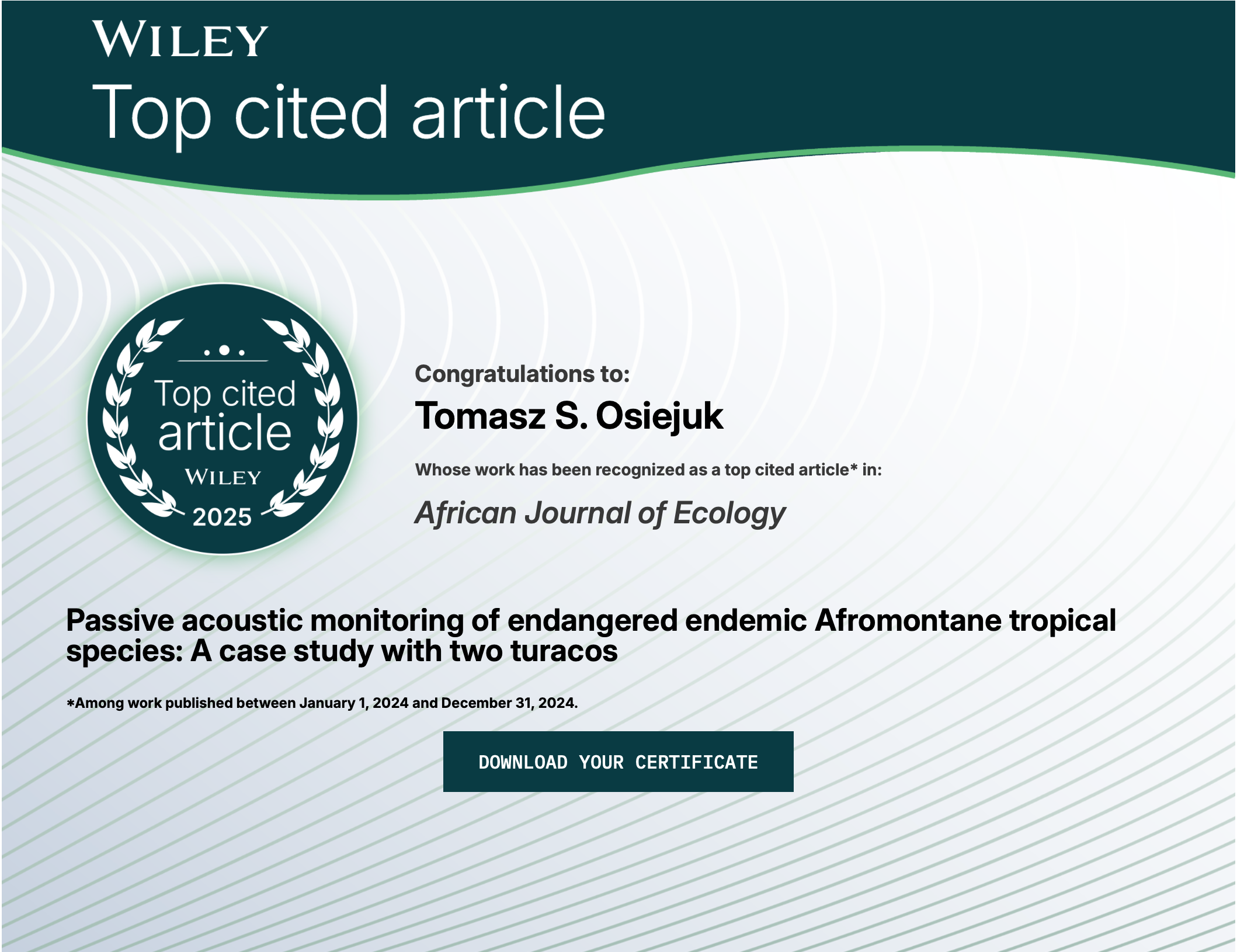
Winiarska D, Budka M, Perez-Granados C, Osiejuk TS (2024) Passive acoustic monitoring of endangered endemic Afromontane tropical species: a case study with two turacos. African Journal of Ecology 62:e13280. DOI: 10.1111/aje.13280
10th Marcin Antczak Award for Adriana Cibik Holoskova
18/10/25 19:21
The 10th Marcin Antczak Award for the most inspiring ornithological papers published in 2024 in a peer-reviewed journal by a young scientist from Poland, the Czech Republic, or Slovakia goes to Adriana Cíbik Hološková from the Faculty of Science at Charles University, who is originally from Slovakia.
The International Board of Marcin Antczak Award appointed by the Dean of the Faculty of Biology of Adam Mickiewicz University, decided that the most inspiring ornithological papers of the last year are:
Hološková A, Cíbik J, Reif J (2024) Why do open-farmland specialist birds prefer small fields? The evaluation of mechanisms using a cross-border study. Global Ecology and Conservation 56:e03327. https://doi.org/10.1016/j.gecco.2024.e03327
Hološková A, Kadlec T, Reif J (2024) Synergic effects of vegetation structure and food supply underlie higher abundance of a farmland specialist bird in organic than in conventional arable fields. Global Ecology and Conservation 51:e02912.
https://doi.org/10.1016/j.gecco.2024.e02912
Hološková A, Reif J (2024) Factors shaping insectivorous farmland bird abundance in intensively cultivated arable fields: Insights through the former Iron Curtain. Agriculture, Ecosystems and Environment 360:108772.
https://doi.org/10.1016/j.agee.2023.108772
Adriana Cíbik Hološková’s research has brought new perspectives by focusing on Slovakia, where farmland is dominated by exceptionally large fields – a legacy of agricultural collectivisation. This unique context, distinct from the small-scale mosaic landscapes of Western Europe, offers crucial insights into the drivers of farmland bird declines. Her studies showed that in such oversized fields, the suitability of crops and vegetation structure, rather than food supply alone, determines breeding success of species like the Yellow Wagtail. She also demonstrated that organic farming, even within vast monocultures, supports higher Skylark abundance through richer invertebrate communities and more favourable vegetation. A cross-border comparison with Austria revealed that small, diverse fields consistently host more Skylarks, underlining the importance of crop diversity and landscape heterogeneity. By exposing the ecological risks of large-scale fields, her work directly informs debates on the Common Agricultural Policy in Slovakia, underpinning proposals for buffer strips, crop diversification, and measures tailored to Central and Eastern European farming systems.
Dr. Adriana Cíbik Hološková is an ornithologist specialising in the agroecology and conservation of farmland birds in Central and Eastern Europe. She earned her PhD in Environmental Science at Charles University in Prague as part of the prestigious STARS programme, focusing on the factors driving changes in farmland bird populations in intensively cultivated landscapes. Besides her research, she is actively involved in policy work as a member of the BirdLife Europe Agriculture Task Force. Nationally, she works within the Slovak Ornithological Society/BirdLife Slovakia on agricultural policy, advocating for biodiversity-friendly reforms of the Common Agricultural Policy and the inclusion of farmland conservation targets. She has also taken part in several international and national conservation projects, including the LIFE Steppe on Border initiative, which aims at habitat restoration for steppe birds. Through this blend of research, policy, and conservation efforts, she helps link ecological science with practical solutions for sustainable agriculture.
Initially, the International Board of the Marcin Antczak Award screened over six hundred papers and, after an initial selection, considered 19 individuals and their articles published last year. The process took over three months, and by the end, we had considered, in addition to the awarded Dr. Adriana Cíbik Hološková, the Board also wishes to recognise Dominika Winiarska from Adam Mickiewicz University in Poznań, Poland, for her papers on passive acoustic monitoring in European and African birds, published in Ecological Indicators, Scientific Reports, Emu, and the African Journal of Ecology; and Ondrej Fišer from the University of South Bohemia, České Budějovice, Czech Republic, for his experimental study on how manipulated body size of potential predators affects nest predator recognition by potential targets, breeding red-backed shrikes, published in Animal Behaviour.
MARCIN ANTCZAK AWARD FOR THE MOST INSPIRING ORNITHOLOGICAL PAPER PUBLISHED IN 2024
The Marcin Antczak Award is given annually for an outstanding and inspiring ornithological paper(s) published in the previous year in a peer-reviewed journal. The prize is aimed at young ornithologists from Poland, the Czech Republic, or Slovakia, or from any other country if the research underlying the paper was conducted in one of these countries. Candidates can be amateurs or pre-doctoral researchers, or individuals who obtained their doctoral degree within the last seven years. For the benefit of nominees, maternity, paternity, or illness leaves are recognised, with the principle that such leaves can extend the age limit by a minimum of one year. The ideas presented in the awarded paper must be strongly related to the field of ornithology; studies on challenging and charismatic species (or topics) will be favoured. The nominee must be the sole author, or the leading (the first and corresponding) author of a multi-author paper and should have played a prominent role in shaping the publication.
This award comes with a diploma, a unique, hand-made silver shrike badge, as well as a cash prize. The awarded Author must agree to give a lecture in Poznań (Poland); the inviting institution will cover costs. Details about the award will be published in Acta Ornithologica.
Between 2024 and 2028, the International Board of the Marcin Antczak Award consists of Dr Peter Adamík (Palacký University Olomouc, Czech Republic), Dr Thorsten J.S. Balsby (Aarhus University, Denmark), Prof. Tomasz S. Osiejuk (Adam Mickiewicz University in Poznań, Poland), Prof. Svein Dale (Norwegian University of Life Sciences, Ås, Norway), Dr Martin Korňan (Technical University in Zvolen, Slovakia), Prof. Tomasz D. Mazgajski (Museum and Institute of Zoology, Polish Academy of Sciences, Warsaw), Prof. Piotr Minias (University of Łódź, Poland), Prof. Jiří Reif (Charles University in Prague, Czech Republic), Dr Katerina Sam (Biology Centre of Czech Academy of Sciences, České Budějovice), Dr Jakub Szymkowiak (Forest Biology Center, Adam Mickiewicz University in Poznań, Poland), Dr Michal Šulc (Institute of Vertebrate Biology, Academy of Sciences of the Czech Republic, Brno), Prof. Piotr Tryjanowski (University of Life Sciences in Poznań, Poland / Institute of Advanced Study TUM, Garching, Germany & Chair of Ecoclimatology, TUM, Freising, Germany), and Prof. Katarzyna Wojczulanis-Jakubas (University of Gdańsk, Poland).
Current information about the Award can be found at https://www.behaecol.web.amu.edu.pl/MAA/
On behalf of the Board,
Tomasz S. Osiejuk
The International Board of Marcin Antczak Award appointed by the Dean of the Faculty of Biology of Adam Mickiewicz University, decided that the most inspiring ornithological papers of the last year are:
Hološková A, Cíbik J, Reif J (2024) Why do open-farmland specialist birds prefer small fields? The evaluation of mechanisms using a cross-border study. Global Ecology and Conservation 56:e03327. https://doi.org/10.1016/j.gecco.2024.e03327
Hološková A, Kadlec T, Reif J (2024) Synergic effects of vegetation structure and food supply underlie higher abundance of a farmland specialist bird in organic than in conventional arable fields. Global Ecology and Conservation 51:e02912.
https://doi.org/10.1016/j.gecco.2024.e02912
Hološková A, Reif J (2024) Factors shaping insectivorous farmland bird abundance in intensively cultivated arable fields: Insights through the former Iron Curtain. Agriculture, Ecosystems and Environment 360:108772.
https://doi.org/10.1016/j.agee.2023.108772
Adriana Cíbik Hološková’s research has brought new perspectives by focusing on Slovakia, where farmland is dominated by exceptionally large fields – a legacy of agricultural collectivisation. This unique context, distinct from the small-scale mosaic landscapes of Western Europe, offers crucial insights into the drivers of farmland bird declines. Her studies showed that in such oversized fields, the suitability of crops and vegetation structure, rather than food supply alone, determines breeding success of species like the Yellow Wagtail. She also demonstrated that organic farming, even within vast monocultures, supports higher Skylark abundance through richer invertebrate communities and more favourable vegetation. A cross-border comparison with Austria revealed that small, diverse fields consistently host more Skylarks, underlining the importance of crop diversity and landscape heterogeneity. By exposing the ecological risks of large-scale fields, her work directly informs debates on the Common Agricultural Policy in Slovakia, underpinning proposals for buffer strips, crop diversification, and measures tailored to Central and Eastern European farming systems.
Dr. Adriana Cíbik Hološková is an ornithologist specialising in the agroecology and conservation of farmland birds in Central and Eastern Europe. She earned her PhD in Environmental Science at Charles University in Prague as part of the prestigious STARS programme, focusing on the factors driving changes in farmland bird populations in intensively cultivated landscapes. Besides her research, she is actively involved in policy work as a member of the BirdLife Europe Agriculture Task Force. Nationally, she works within the Slovak Ornithological Society/BirdLife Slovakia on agricultural policy, advocating for biodiversity-friendly reforms of the Common Agricultural Policy and the inclusion of farmland conservation targets. She has also taken part in several international and national conservation projects, including the LIFE Steppe on Border initiative, which aims at habitat restoration for steppe birds. Through this blend of research, policy, and conservation efforts, she helps link ecological science with practical solutions for sustainable agriculture.
Initially, the International Board of the Marcin Antczak Award screened over six hundred papers and, after an initial selection, considered 19 individuals and their articles published last year. The process took over three months, and by the end, we had considered, in addition to the awarded Dr. Adriana Cíbik Hološková, the Board also wishes to recognise Dominika Winiarska from Adam Mickiewicz University in Poznań, Poland, for her papers on passive acoustic monitoring in European and African birds, published in Ecological Indicators, Scientific Reports, Emu, and the African Journal of Ecology; and Ondrej Fišer from the University of South Bohemia, České Budějovice, Czech Republic, for his experimental study on how manipulated body size of potential predators affects nest predator recognition by potential targets, breeding red-backed shrikes, published in Animal Behaviour.
MARCIN ANTCZAK AWARD FOR THE MOST INSPIRING ORNITHOLOGICAL PAPER PUBLISHED IN 2024
The Marcin Antczak Award is given annually for an outstanding and inspiring ornithological paper(s) published in the previous year in a peer-reviewed journal. The prize is aimed at young ornithologists from Poland, the Czech Republic, or Slovakia, or from any other country if the research underlying the paper was conducted in one of these countries. Candidates can be amateurs or pre-doctoral researchers, or individuals who obtained their doctoral degree within the last seven years. For the benefit of nominees, maternity, paternity, or illness leaves are recognised, with the principle that such leaves can extend the age limit by a minimum of one year. The ideas presented in the awarded paper must be strongly related to the field of ornithology; studies on challenging and charismatic species (or topics) will be favoured. The nominee must be the sole author, or the leading (the first and corresponding) author of a multi-author paper and should have played a prominent role in shaping the publication.
This award comes with a diploma, a unique, hand-made silver shrike badge, as well as a cash prize. The awarded Author must agree to give a lecture in Poznań (Poland); the inviting institution will cover costs. Details about the award will be published in Acta Ornithologica.
Between 2024 and 2028, the International Board of the Marcin Antczak Award consists of Dr Peter Adamík (Palacký University Olomouc, Czech Republic), Dr Thorsten J.S. Balsby (Aarhus University, Denmark), Prof. Tomasz S. Osiejuk (Adam Mickiewicz University in Poznań, Poland), Prof. Svein Dale (Norwegian University of Life Sciences, Ås, Norway), Dr Martin Korňan (Technical University in Zvolen, Slovakia), Prof. Tomasz D. Mazgajski (Museum and Institute of Zoology, Polish Academy of Sciences, Warsaw), Prof. Piotr Minias (University of Łódź, Poland), Prof. Jiří Reif (Charles University in Prague, Czech Republic), Dr Katerina Sam (Biology Centre of Czech Academy of Sciences, České Budějovice), Dr Jakub Szymkowiak (Forest Biology Center, Adam Mickiewicz University in Poznań, Poland), Dr Michal Šulc (Institute of Vertebrate Biology, Academy of Sciences of the Czech Republic, Brno), Prof. Piotr Tryjanowski (University of Life Sciences in Poznań, Poland / Institute of Advanced Study TUM, Garching, Germany & Chair of Ecoclimatology, TUM, Freising, Germany), and Prof. Katarzyna Wojczulanis-Jakubas (University of Gdańsk, Poland).
Current information about the Award can be found at https://www.behaecol.web.amu.edu.pl/MAA/
On behalf of the Board,
Tomasz S. Osiejuk